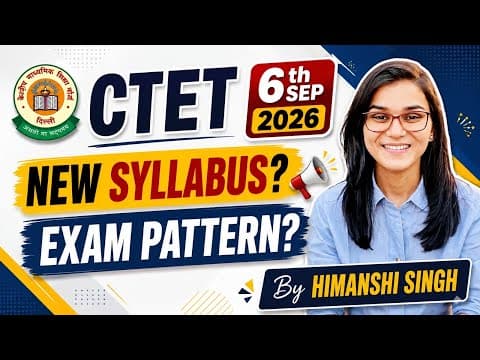
Name Of The Post
This post seems outdated. Click CTET July 2026 Recruitment
Last Updated
Highlighted Information
Importance of the Post
About this Syllabus
Quick Information
Department
Stage Level
Job Type
Exam Mode
Applicants Gender
Syllabus Content
~2 min read| Section | Topics |
|---|---|
| Child Development & PedagogyChild Development & Pedagogy | Concept of development & relationship with learning; Principles of child development; Influence of heredity & environment; Socialisation; Theories of Piaget, Kohlberg, Vygotsky; Concept of intelligence; Multi-dimensional intelligence; Language & thought; Gender as a social construct; Individual differences; Inclusive education; Assessment for learning.Concept of development & relationship with learning; Principles of child development; Influence of heredity & environment; Socialisation; Theories of Piaget, Kohlberg, Vygotsky; Concept of intelligence; Multi-dimensional intelligence; Language & thought; Gender as a social construct; Individual differences; Inclusive education; Assessment for learning. |
| Language I — ComprehensionLanguage I — Comprehension | Two unseen passages — one prose & one poem — followed by linguistic comprehension, language and grammar based questions. Pedagogy of language development — learning & acquisition, principles of language teaching, role of listening & speaking, oral & written communication, teaching-learning materials, evaluation. |
Eligibility
Minimum Qualification
Bachelor's / Master's / B.Ed per postBachelor's / Master's / B.Ed per post
Download Instructions
- To download the official syllabus PDF for CTET July 2026 — Syllabus: 1) Visit the official website at [Link Provided Below].
- 2) Navigate to 'Notification' / 'Information Bulletin' / 'Syllabus' from the main menu or homepage.
- 3) Locate the latest cycle's notification PDF and open it — the syllabus is published as part of the notification or as a separate appendix.
- 4) Cross-check the syllabus on this page section-by-section against the source PDF; the page summarises the official content for quick revision.
- 5) For any clarification, refer to the FAQ section of the official website or contact the helpline listed in the notification.
- Subscribe to the official email-alert / SMS list to receive updates whenever the syllabus is revised.
- To download the official syllabus PDF for CTET July 2026 — Syllabus: 1) Visit the official website at [Link Provided Below].
- 2) Navigate to 'Notification' / 'Information Bulletin' / 'Syllabus' from the main menu or homepage.
- 3) Locate the latest cycle's notification PDF and open it — the syllabus is published as part of the notification or as a separate appendix.
- 4) Cross-check the syllabus on this page section-by-section against the source PDF; the page summarises the official content for quick revision.
- 5) For any clarification, refer to the FAQ section of the official website or contact the helpline listed in the notification.
- Subscribe to the official email-alert / SMS list to receive updates whenever the syllabus is revised.
Important Dates
| Application Start Date | 16th March 202616th March 2026 |
| Application End Date | 14th April 202614th April 2026 |
Important Links
| Official Website |
Related Posts
Apply for CTET January 2026; full syllabus available for review
Apply for REET 2026 recruitment; full syllabus available for review
Apply for Indian Army TES 2026; syllabus details available for review
Apply for UPTET 2026; full syllabus available for review before application
Apply for SSC CGL Tier-I 2026 recruitment; full syllabus available for review
Apply for SSC JE 2026 recruitment; detailed syllabus available for review
Apply for Indian Army SSC (Tech) 2026 recruitment; full syllabus available for review
Apply for IISER IAT 2026; official syllabus now available for review